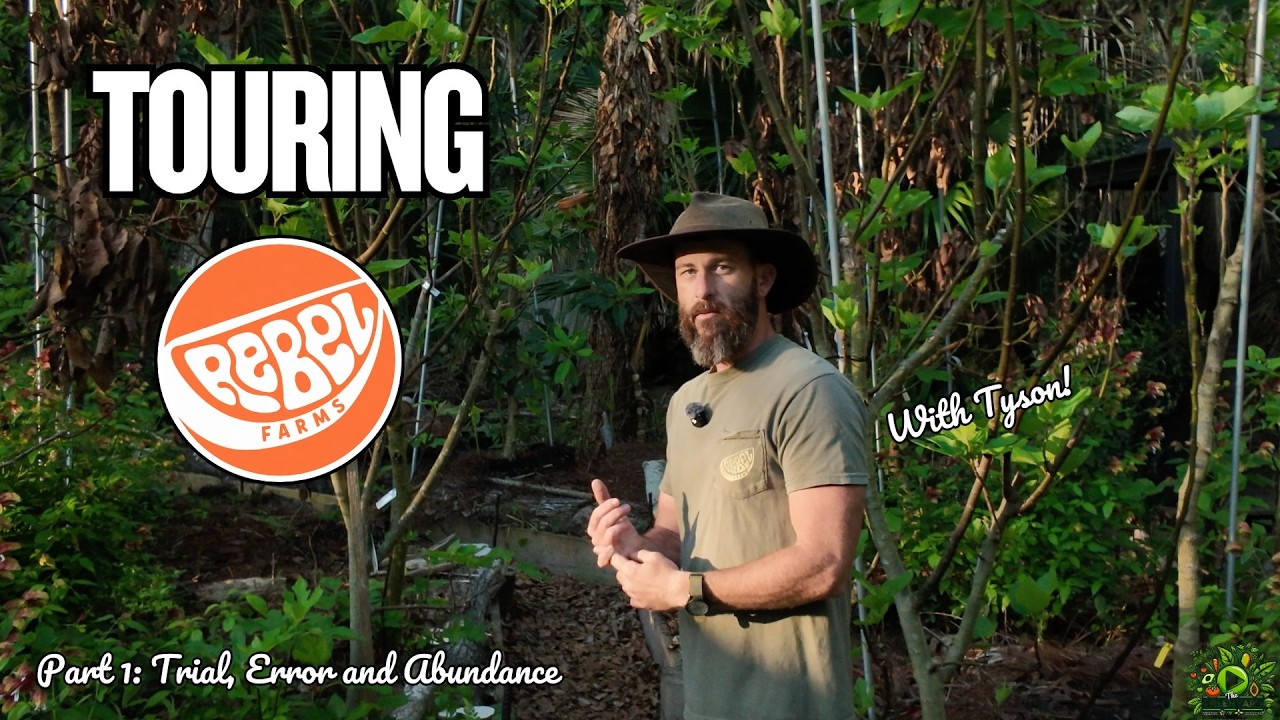
Rebel Farms Tour Highlight
A closer look at one of the plants, lessons, or growing systems featured during Part 1 of our Rebel Farms visit.
Rebel Farms, New Smyrna Beach food forest, Florida food forest, Florida agroforestry, tropical fruit Florida, cold hardy avocado Florida, community food forest, suburban food forest, freeze tolerant fruit trees, flood tolerant food forest, Florida tropical fruit, experimental food forest
Tour Rebel Farms, an experimental food forest and growing community in New Smyrna Beach where Tyson and Maggie are using real-world successes, failures, freezes, floods, and cultivar testing to learn what can reliably produce in this part of Florida.
Rebel Farms is an experiment in both agriculture and community. Five houses, five families, and ten young children live as neighbors while growing food, sharing harvests, building soil, and testing which crops can handle the challenging combination of heat, flooding, wind, salt exposure, and occasional hard freezes near New Smyrna Beach, Florida.
Tyson describes Rebel Farms as an experiment in agriculture and community. The project is spread through a historically suburban neighborhood where five families live beside one another and farm together. Each household has its own kitchen garden based on available light and growing conditions, and the families can trade what they produce.
That same experimental approach extends into the larger food forest systems. One area may be used to test citrus while another is planted beneath a native oak and palm canopy. Avocados, bananas, starfruit, sapodillas, mangoes, figs, gingers, turmeric, passion fruit, Monstera, and other crops are grown in different situations to see what actually succeeds.
The purpose is not simply plant collecting. Rebel Farms wants data. Tyson explains that the lessons learned on these smaller sites can guide future plantings at a much larger scale, reducing the chance of making expensive mistakes after hundreds of trees have already been planted.
One tree Tyson repeatedly praises is calamondin. At Rebel Farms it has shown the ability to grow quickly, flower heavily, and continue producing in areas receiving only a few hours of strong sun. Tyson uses the small acidic fruit more like a cooking lime than a sweet citrus.
The tree has also survived conditions that matter far more to Rebel Farms than appearance alone. Tyson says their calamondin has lived through major flooding and the recent freeze while continuing to flower and hold fruit. Because Rebel Farms is looking for dependable production, that combination of resilience and usefulness makes it a particularly valuable crop.
Another section of Rebel Farms uses a different strategy entirely. Native oaks and palms remain overhead while food-producing plants fill the understory. Tyson describes the canopy as both a windbreak and a way to reduce intense summer sun, which also lowers water demand in a system that currently has no permanent irrigation.
Under the canopy are rows and pockets of avocados, bananas, starfruit, Monstera, passion fruit, gingers, turmeric, citrus, and other tropical and subtropical crops. Material damaged by the freeze is chopped and dropped back onto the soil rather than hauled away.
That organic material becomes part of an accumulating layer of mulch and future compost. Because the area can experience roughly three feet of flood water during major events, the paths also help move water toward lower points in the property.
The tour was filmed only about a month after one of the most destructive weather events the farm had experienced. Tyson says temperatures fell into the 23–25°F range across different microclimates and remained severely cold for three days in a row.
The losses were substantial. Bananas died back, many gingers and turmerics were lost, passion fruit vines were damaged, and most mangoes did not appear likely to survive above their grafts. Jackfruit, breadfruit, ice cream bean, tropical cherries, acerola, and Jamaican strawberry tree were among the other casualties. Tyson estimated that roughly half of their crop was lost.
Showing that damage is important to the Rebel Farms story. This is a working experiment, and failure changes what gets planted next. The goal is to learn those lessons here before repeating the same mistake across a much larger commercial planting.
A closer look at one of the plants, lessons, or growing systems featured during Part 1 of our Rebel Farms visit.
Another quick lesson from Rebel Farms and its approach to testing crops under real Florida conditions.
Before the freeze, a roughly 300-square-foot area behind the pool could hold six to twelve banana racks at one time. Tyson describes the patch as an almost self-renewing system: new pups emerge while mature pseudostems fruit, and after harvest the old stalk is chopped into pieces and returned to feed the next generation.
The cultivar used heavily at Rebel Farms is Dwarf Orinoco. Tyson likes it because it stays relatively short, handles wind and salt exposure, grows quickly, and produces fruit that can be eaten fresh or cooked. The freeze, however, clarified its limits. The plants died back and the farm lost around 40 racks of bananas.
Even after that failure, Tyson still considers Dwarf Orinoco one of the better banana options they have tested for Florida because of its speed, size, wind tolerance, salt tolerance, and ability to recover from the ground.
Avocados may provide the clearest example of why Rebel Farms tests plants before scaling. Lula had previously been a favored variety, but several Lula trees were badly damaged by the freeze. Fantastic avocado performed very differently.
Older Fantastic trees came through the cold in good condition, held flowers, and were already setting young avocados. Tyson says that result convinced them to replace less reliable trees and increase future plantings of Fantastic. Joey and Poncho were also mentioned among the cultivars that showed strong cold tolerance.
Taste still matters, and Tyson openly notes that Fantastic is not necessarily their favorite avocado for eating. But the farm is evaluating the whole package: vigor, production, water tolerance, freeze tolerance, and how quickly a tree begins providing meaningful yields.
Rebel Farms does not evaluate every plant only as a direct harvest crop. Figs around the avocado area are also used as a diversion for birds. The idea is that birds arriving for fruit encounter figs first, reducing some of the pressure on the avocado crop behind them.
Citrus is used both for production and as part of the understory. Tyson particularly values everbearing types because they spread production across the year instead of producing one short seasonal crop. Persian lime, Meyer lemon, calamondin, and Lakeland limequat are among the types discussed during the tour.
This reflects a larger design philosophy at Rebel Farms: the most valuable plants often do more than one job. A tree can produce fruit while also serving as shade, wind protection, wildlife diversion, pollinator support, or part of the nutrient cycle.
The community is also working toward greater self-sufficiency in fertility. Food scraps, weeds, and other organic material from the different families are brought to the chicken area. The chickens break up the material, mix it, and add manure.
Once that material reaches the right stage, it is moved into compost bins, turned, and allowed to finish from hot compost into cold, usable compost. The finished material is then distributed to whichever garden area needs it most.
For Rebel Farms, this closes another loop. Household food waste and garden waste become fertility, fertility supports new crops, and those crops feed the families who contribute material back into the system.
Part 1 of the Rebel Farms tour includes a mix of productive crops, trial cultivars, tropical species recovering from freeze damage, support plants, and plants being evaluated for future expansion.
Rebel Farms shows why failure can be one of the most useful parts of growing food. A plant tag may describe a tree as cold hardy, but a real freeze can reveal which cultivars actually survive, recover, flower, and continue producing in a specific place.
Tyson and Maggie are using those lessons to move beyond the idea of a food forest as something that simply looks abundant. Their goal is production: finding plants that can reliably feed people and then applying those lessons across larger pieces of land.
That willingness to test, lose plants, change direction, and try again is what makes Rebel Farms such an interesting example of abundance in progress.
Rebel Farms offers tours and welcomes questions about growing food, food forests, and the systems they are developing in New Smyrna Beach. Visit their website or follow their work online to learn more.