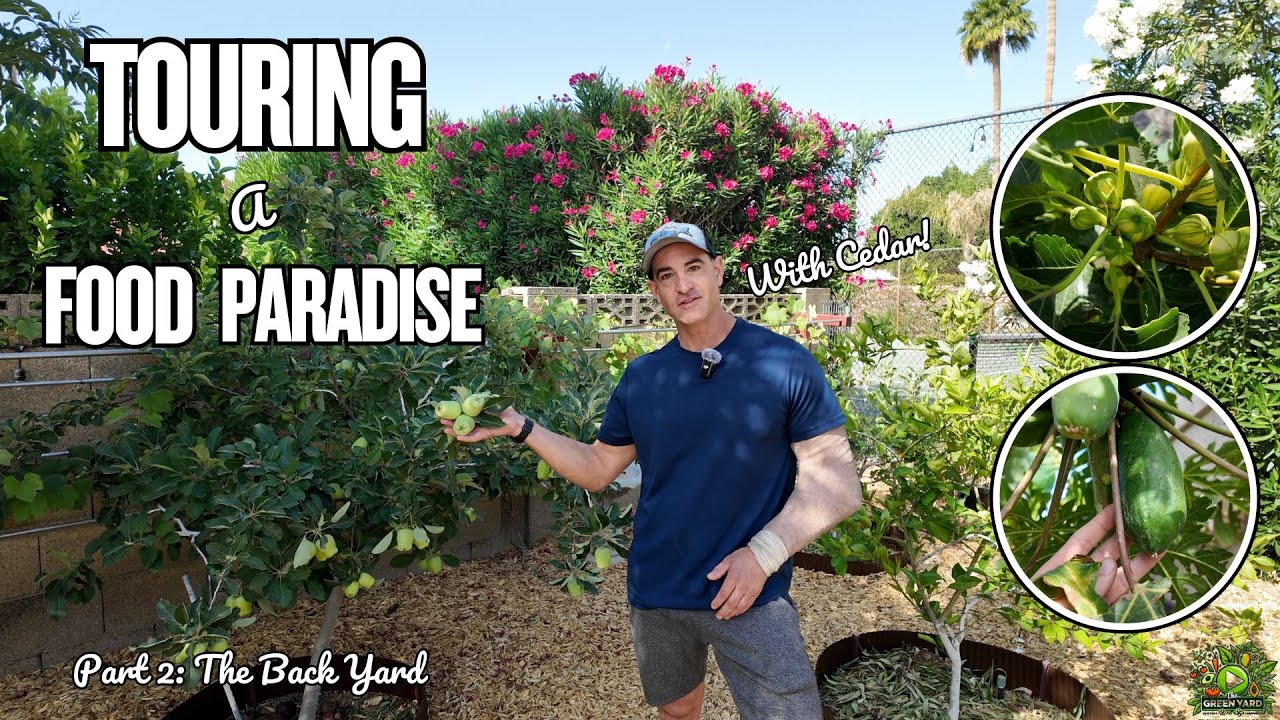
Glendale Front Yard Food Forest Tour: Cedar’s Arizona Fruit Orchard
Glendale food forest, Arizona front yard orchard, Cedar food forest, Glendale Arizona garden, low chill peaches Arizona, growing peaches in Phoenix, Arizona apricot tree, desert fruit trees, Phoenix edible landscaping, Arizona food forest, front yard food forest, growing figs in Arizona, growing blackberries in Phoenix, desert microclimates, Sonoran Desert gardening
Cedar’s Productive Front Yard Food Forest in Glendale, Arizona
Tour Cedar’s productive Glendale front yard, where low-chill peaches, apricots, figs, mulberries, blackberries, persimmons, and experimental tropical fruit grow together through careful pruning and desert microclimates.
Cedar’s Glendale property begins with a highly productive front yard orchard built around peaches, apricots, figs, berries, and a growing collection of experimental subtropical plants. Throughout the tour, he shares which varieties have produced reliably, where pruning decisions created problems, and how shade from vigorous trees helps less heat-tolerant plants survive the Sonoran Desert.
Inside Cedar’s Glendale Front Yard Orchard
The front yard is centered around several low-chill peach varieties selected for the Phoenix area. Tropic Snow, Florida Prince, and Desert Gold each provide a different harvest window, flavor, and growth habit, allowing Cedar’s family to pick peaches across more of the warm season.
The trees are highly productive, but that abundance creates its own challenges. Heavy crops can pull branches downward or break limbs, especially when trees are trained too wide. Cedar has begun moving away from an extremely open goblet shape and is training new growth slightly more upright to maintain stronger structure.
Apricots, mulberries, figs, blackberries, persimmons, and experimental seedlings fill the spaces around the peaches. Together they create a front yard that is both a working orchard and an ongoing test of which fruit crops can perform reliably in Glendale’s heat.
What You’ll Learn From This Arizona Food Forest
Growing Low-Chill Peaches in Glendale
Tropic Snow is a white-fleshed freestone peach that flowers early but ripens later than Cedar’s other peach trees. The fruit is sweet with relatively little tartness, and the tree can continue producing into mid-July. Its broad growth habit has also shown Cedar why peach trees need to be trained with future crop weight in mind.
Florida Prince is the family favorite for flavor, combining sweetness with noticeable tartness. A warm winter caused the tree to flower and ripen earlier than usual, and extensive winter pruning reduced the crop but helped Cedar begin correcting a structure that had become too wide.
Desert Gold is the most vigorous and productive peach in the front yard. Even after Cedar removed hundreds of young peaches, the remaining crop still weighed branches downward. The tree handles summer heat well, but its heavy production requires thinning, netting, and repeated pruning to prevent broken limbs and keep fruit within reach.
Apricots, Mulberries, and a Developing Desert Canopy
Cedar’s Katy apricot has become more productive as it matures. The fruit is mostly sweet and relatively small, but the tree now provides daily harvests during its season. Cedar hopes to use some of the crop for jam, where the mild fruit can gain additional flavor and usefulness.
Nearby, a Pakistan mulberry functions as both a fruit tree and a major shade tree. Cedar cuts it back to roughly seven feet during winter, yet it can add around fifteen feet of growth during the warm season. The large canopy protects nearby plants from harsh western and northern exposure while still producing fruit enjoyed by the family.
This relationship shows how a desert food forest can become easier to grow as it matures. A vigorous support tree may eventually create the cooler root zones and filtered afternoon light needed by persimmons, mango seedlings, berries, and other sensitive plants.
Figs, Berries, and Experimental Fruit Trees
Several of the most promising plants began as small cuttings or seedlings. A Peter’s Honey fig and Tiger Panache fig both started as tiny cuttings shared by another grower. After only a few seasons, they are carrying substantial crops, demonstrating how quickly figs can become productive in Arizona when given a suitable location.
A Prim-Ark Freedom blackberry produces unusually large fruit but shows clear stress from afternoon sun. Cedar is allowing a nearby Hong Kong orchid tree to develop into a shade canopy that may eventually improve the berry’s microclimate. The same section previously lost plants because surrounding walls trapped heat and functioned like an oven.
White sapote, peach, starfruit, cherimoya, mango, and other seedlings remain experiments. Some may eventually produce worthwhile fruit, while others can become rootstock for proven varieties. Cedar’s approach allows the garden to keep evolving without requiring every young plant to have a guaranteed outcome.
Plants Growing in Cedar’s Front Yard
Cedar’s front yard combines proven low-chill stone fruit with berries, figs, subtropical trees, seedlings, shade trees, and ornamentals. The collection is smaller than the backyard food forest, but each plant is carefully evaluated for productivity, fruit quality, heat tolerance, and its ability to improve the surrounding microclimate.
Show Complete Plant List Hide Complete Plant List
Peaches and Apricots
- Tropic Snow peach
- Florida Prince peach
- Desert Gold peach
- Peach seedling
- Katy apricot
- Gold Kist apricot, formerly grown
Figs, Berries, and Mulberries
- Peter’s Honey fig
- Tiger Panache fig
- Prim-Ark Freedom blackberry
- Pakistan mulberry
Subtropical and Experimental Fruit
- Jiro persimmon
- Keitt mango seedling
- White sapote seedling
- Starfruit rootstock seedling
- Cherimoya seedling
- Red grapefruit
- Natal plum
Support and Ornamental Plants
- Royal poinciana
- Hong Kong orchid tree
- Confederate rose
- Artichoke
The Green Yard Takeaway
Cedar’s front yard shows that productive desert orchards require more than choosing low-chill varieties. Heavy crops must be thinned, branches need to be trained for strength, and the heat reflected from walls can be just as important as the amount of direct sunlight a plant receives.
The garden also demonstrates the long-term value of building living shade. Vigorous trees such as mulberries can provide fruit while creating the protected conditions needed by berries, persimmons, seedlings, and subtropical experiments. Over time, the front yard becomes more than an orchard—it becomes a network of increasingly useful microclimates.
Continue Learning With The Green Yard
Cedar’s front yard is only the beginning of this Glendale property. His backyard contains an even larger collection of tropical fruit, grafting experiments, grapes, figs, pomegranates, bananas, avocados, and other plants being tested in the Sonoran Desert.
Continue Exploring Cedar’s Food Forest