Growing Fruit Trees as Long-Term Experiments
Ryan explains how seedlings can reveal cold tolerance, local adaptation, and the possibility of a valuable new fruit variety.
Central Florida food forest, Food Forest Florida, Florida food forest tour, secret garden Florida, tropical fruit Florida, fruit trees Zone 9B, Florida permaculture, growing bananas in Florida, oak tree microclimate, Ryan Food Forest Florida
Tour Food Forest Florida, a diverse Zone 9B food forest where Ryan grows tropical fruit beneath mature oak trees using compost, seedlings, microclimates, and creative growing systems.
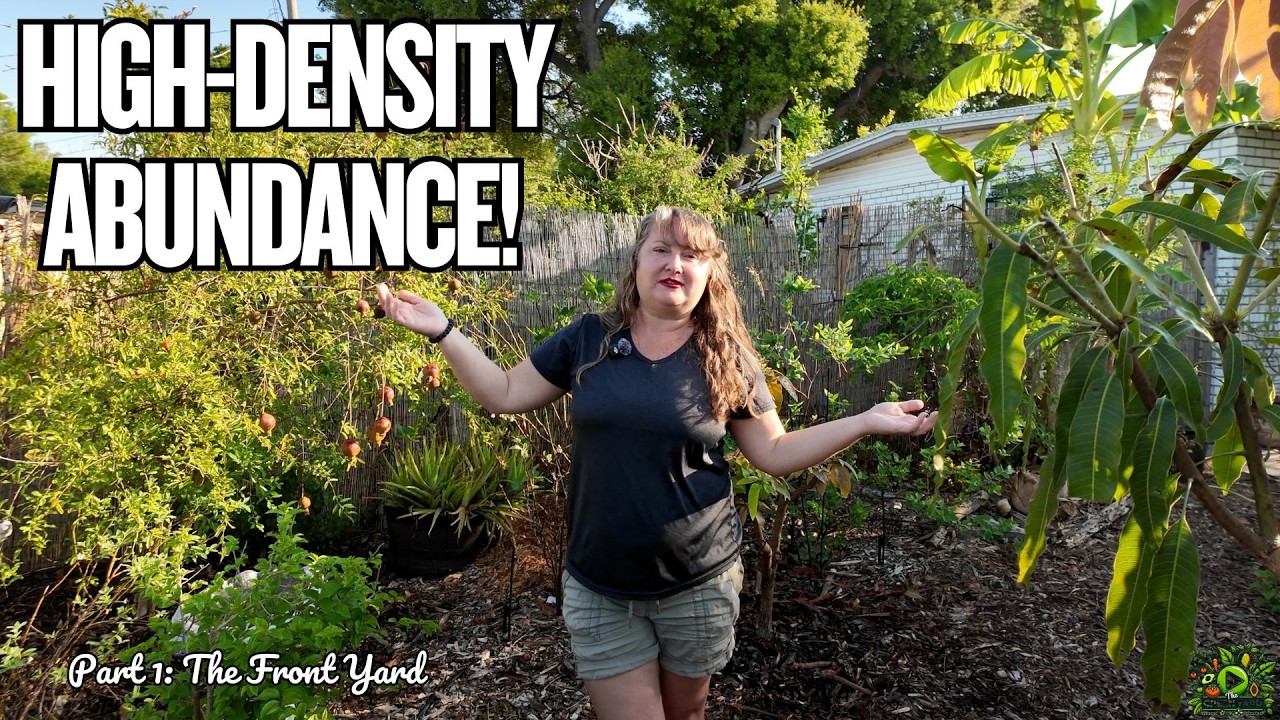
In Part 1 of our visit to Food Forest Florida, Ryan takes us through the area he calls his Secret Garden, a productive growing space tucked beneath mature oak trees just north of Tampa. The tour explores tropical fruit, homemade compost, seed-grown experiments, cold protection, banana systems, and the ways Ryan works with the existing landscape rather than trying to replace it.
Ryan calls this section of the property his Secret Garden because it is tucked among mature oak trees. Instead of clearing the existing canopy to create a conventional orchard, he uses the trees as part of the food forest’s structure.
Dying trees and fallen logs become borders for new garden beds. The wood creates habitat for fungi and other decomposers, while unfinished compost and wood-chip mulch gradually break down inside the beds and form new soil.
Beneath and around the oak canopy, Ryan grows moringa, blueberries, passion fruit, starfruit, yerba mate, bananas, malanga, beautyberry, pineapples, citrus seedlings, avocados, mulberries, and many other edible plants. The result is a layered garden that makes productive use of spaces that might otherwise remain empty beneath large trees.
Ryan explains how seedlings can reveal cold tolerance, local adaptation, and the possibility of a valuable new fruit variety.
Ryan explains why he plants citrus beneath oak canopies and discusses the possible relationship between oak-leaf tannins and healthier citrus trees.
Ryan tests whether large tropical foliage can surround a sensitive jackfruit tree and provide additional protection during winter freezes.
One of the strongest lessons from Food Forest Florida is that an existing tree canopy does not have to prevent food production. Ryan uses mature live oaks to create protected growing spaces with dappled light, leaf litter, and reduced exposure to wind and cold.
A healthy seed-grown citrus tree is planted beneath the oak canopy. Ryan believes that growing citrus from seed gives individual plants an opportunity to express genetics that may respond differently to citrus greening. He also discusses research into whether tannins from fallen oak leaves may support affected citrus trees.
Pineapples are planted directly around the base of another oak tree. Their shallow growth habit allows them to occupy space above the oak roots, and their low-maintenance nature makes them well suited to this protected understory location.
Ryan is willing to dedicate space to fruit trees with uncertain outcomes. Several avocados were grown from seeds taken from store-bought or locally grown fruit. A seedling may take years to produce and may not create fruit identical to its parent, but Ryan sees other forms of value in the experiment.
After temperatures reached approximately 24°F, one avocado seedling showed no visible cold damage. Even before it produces fruit, that survival suggests that the tree is capable of growing in Ryan’s soil and climate.
If the eventual fruit is disappointing, the established tree can still serve as locally adapted rootstock for a proven grafted variety. Ryan may also graft part of the tree while allowing another branch to continue growing naturally, preserving the possibility that the seedling could produce a worthwhile new avocado.
The garden sits in USDA Zone 9B, where tropical fruit trees can be challenged by occasional hard freezes. A Black Gold jackfruit planted in an exposed area suffered cold damage, leading Ryan to try a different strategy with another tree.
He planted the jackfruit beneath established philodendrons and cut their leaves back temporarily to provide space. The goal is to allow the jackfruit to grow during the warmer months and then let the philodendron foliage surround it as winter approaches.
Ryan hopes this living enclosure will create a protected pocket around the tree and provide the equivalent of a slightly warmer microclimate. The experiment may not completely eliminate cold damage, but even a small improvement could help tropical trees survive Central Florida winters more reliably.
Organic material produced on and around the property is continually returned to the food forest. Ryan uses a three-bin compost system that begins with household food scraps, leaves, and coffee grounds collected through a partnership with a local coffee shop.
The material moves from the freshest bin into the next stage and eventually becomes finished compost. Ryan describes this homemade compost as the black gold that feeds the fruit trees throughout the property.
A banana circle provides another way to recycle yard debris. Organic material is placed in the center of a ring of banana plants, where it breaks down and releases nutrients into the surrounding root zone. This allows yard waste to become fertility without needing to be removed from the property.
Bananas appear throughout the Secret Garden, but Ryan does not treat every variety as interchangeable. Taller cultivars are placed near the house where the structure offers additional protection from wind.
The Manzano, or apple banana, is one of Ryan’s favorites for flavor. It produces a short, sweet banana with thin skin and a green-apple note beneath the familiar banana flavor.
For overall performance in Florida, Ryan recommends Dwarf Namwa. The plant remains shorter than many banana cultivars and combines wind tolerance, drought tolerance, cold tolerance, dependable production, and good fruit quality. Its shorter stature is especially useful on a property exposed to strong winds from a nearby lake.
Part 1 of the Food Forest Florida tour includes tropical and subtropical fruit trees, bananas, edible roots, beverage plants, berries, support species, and experimental seedlings growing throughout the Secret Garden and surrounding oak understory.
Food Forest Florida shows how abundance can emerge from observation rather than complete control. Ryan does not remove the mature oak trees, export every piece of yard debris, or expect every seedling to produce perfect fruit. He looks for ways each existing element can serve another part of the system.
Oak trees become microclimates, fallen logs become garden beds, coffee grounds become compost, yard scraps feed bananas, and experimental seedlings may become either new varieties or locally adapted rootstock. The garden continues to improve because Ryan is willing to test ideas, observe the results, and let the landscape help determine what comes next.
Watch the complete Secret Garden tour and explore the individual lessons featured in the three companion Shorts from this visit.